
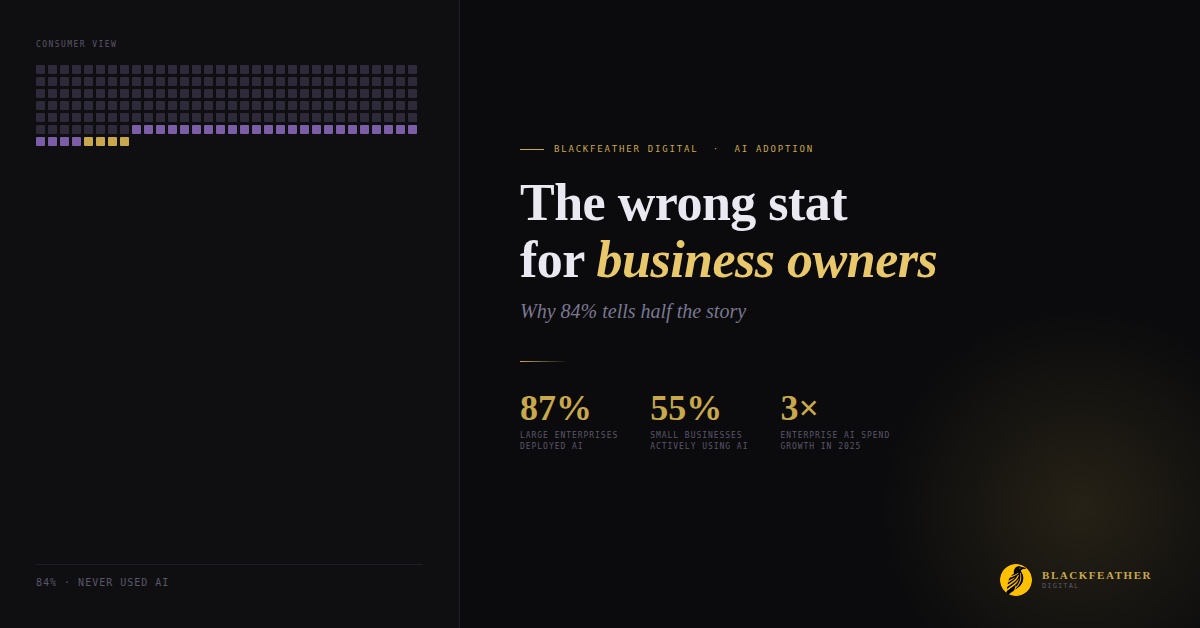
Quick Answer: A viral dot chart showing 84% of humans have never used AI is accurate — but it’s measuring the wrong thing if you run a business. Consumer adoption tells one story. Business-layer deployment tells another. 87% of large enterprises have deployed AI. 55% of small businesses actively use it. The window to build foundational systems before your competitors do is now, not someday.
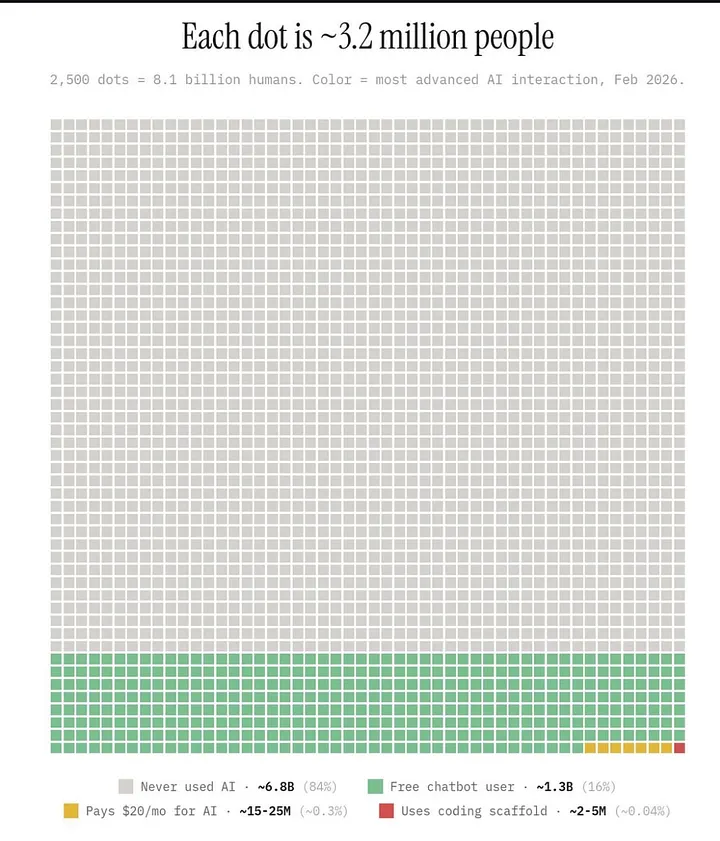
You’ve probably seen it. A grid of 2,500 dots. Each one represents 3.2 million people. Most of the grid is gray. The headline: 84% of humans have never meaningfully used AI.
It’s a clean piece of data visualization. Shareable. Humbling. And if you run a business, it might even feel reassuring — like maybe the AI wave isn’t really here yet. Maybe you still have time.
That’s exactly the wrong takeaway.
The Chart Is Measuring Consumer Behavior.
Your Competition Isn’t Consumers.
The graphic tells a consumer adoption story. It measures individual people and their relationship with chatbot accounts. By that metric, yes — most of the world hasn’t opened a ChatGPT tab.
But if you own a business, that’s not the number that matters to you.
The relevant question isn’t how many people have a free AI account. It’s how many businesses are already embedding AI into the operations that compete with yours. How many workflows — lead follow-up, content production, customer service, project estimation, reporting — are being automated right now, in your market, by businesses that are quietly getting faster and cheaper than you.
That’s a very different picture.
What the Business Layer Actually Looks Like
Here’s the data that wasn’t in the viral chart:
The story the dot chart
didn’t show
Each box = 1M people or 1M businesses depending on panel · Color = AI engagement depth · Feb 2026
Consumer panel = ~335M U.S. adults · Business panels = ~30M U.S. businesses

87% of large enterprises have deployed AI in some form, according to a 2025 enterprise report — not experimenting, not exploring a vendor deck, deployed. Among companies with more than 500 employees, only 13% have no active AI initiative.
55% of small businesses actively use AI as of 2025, up from 39% the year before. That’s a 41% increase in a single year. And among businesses with 10 to 100 employees — the size of most of your direct competitors — adoption hit 68%.
72% of companies worldwide now use AI in at least one function. Sales. Marketing. Operations. Customer service. The list keeps expanding.
Enterprise AI spend hit $37 billion in 2025, up 3x from the year prior. That’s not experimental budget. That’s infrastructure spend.
None of this shows up in a dot grid counting whether individual people have a ChatGPT account.
The Real Divide: Dabbling With AI vs. Building Systems With It
Here’s what actually matters for business owners: there’s a significant difference between using AI and building systems with AI.
Most of the small businesses showing up in adoption surveys are using AI the same way they use Google — to look something up, draft an email, get a quick answer. That’s useful. It’s not transformative.
The businesses building real advantage aren’t just using AI tools. They’re integrating AI into their operational systems — their CRM, their follow-up sequences, their content workflows, their reporting. The output isn’t a better email. It’s a business that runs faster with less friction, captures more leads, and responds to customers before competitors even see the inquiry.
That gap between “dabbling” and “systems-level integration” is where the real competitive distance is being created right now. And it’s happening quietly, without press releases or LinkedIn announcements.
Why the Window Matters
Every technology adoption cycle has a window — a period where early movers get disproportionate advantage before the market normalizes.
We’re in that window right now for AI at the business operations layer. Not because most businesses haven’t heard of AI. They have. It’s because most businesses haven’t moved from awareness to integration. The 51% of small businesses currently “exploring” AI are one decision away from becoming your competition.
The businesses that build the foundation now — clean data, automated workflows, AI-assisted sales systems — aren’t just going to be more efficient. They’re going to be structurally different from competitors who waited. Lower cost per lead. Faster response times. Better content. More consistent follow-up.
By the time 84% of consumers have meaningfully used AI, the business competition will already be over.
The Real Story in the Data
The viral chart wasn’t wrong. It just told an incomplete story.
Consumer AI adoption is still early. Business AI adoption is already well underway. And the gap between businesses that have integrated AI into their systems and those still watching from the sidelines is growing every quarter.
The question for any business owner isn’t “should I pay attention to AI?” It’s “how far behind am I, and what does it cost me to stay there?”
At Blackfeather Digital, we help locally-owned businesses in construction, home improvement, and wellness build the kind of revenue systems that enterprise companies have been deploying for years — without the enterprise price tag or the year-long implementation timeline. If you’re ready to move from exploring to building, let’s talk.